
You know those times when you make a quick choice and later think, “Why did I do that?” That’s where critical thinking Exercises comes in. It helps you pause, look at facts, and pick the best path. In this guide, I’ll show you what critical thinking is, why it matters, and 10 simple exercises to try. We’ll go beyond basics with tips to use them every day, avoid common slips, and track how you get better. By the end, you’ll feel ready to think sharper at work or home.
Contents
- 1 What Is Critical Thinking?
- 2 Why Critical Thinking Matters More Now
- 3 10 Simple Critical Thinking Exercises
- 4 How to Fit These into Your Day
- 5 Common Mistakes and How to Fix Them
- 6 Critical Thinking in the AI Age
- 7 Track Your Progress
- 8 Your Critical Thinking Toolkit
- 9 Build Stronger Thinking Habits
- 10 Conclusion
- 11 FAQs
What Is Critical Thinking?
Critical thinking means you look at info, ask questions, and decide based on proof. It’s not just guessing. You break things down, check if they’re true, and see the big picture.
Key parts include:
- Spot facts from guesses.
- Weigh pros and cons.
- Find root causes.
- Draw fair conclusions.
Think of it as a tool kit for your brain. It keeps you from jumping to wrong ideas. In today’s fast world, it’s key for good choices.
Why Critical Thinking Matters More Now
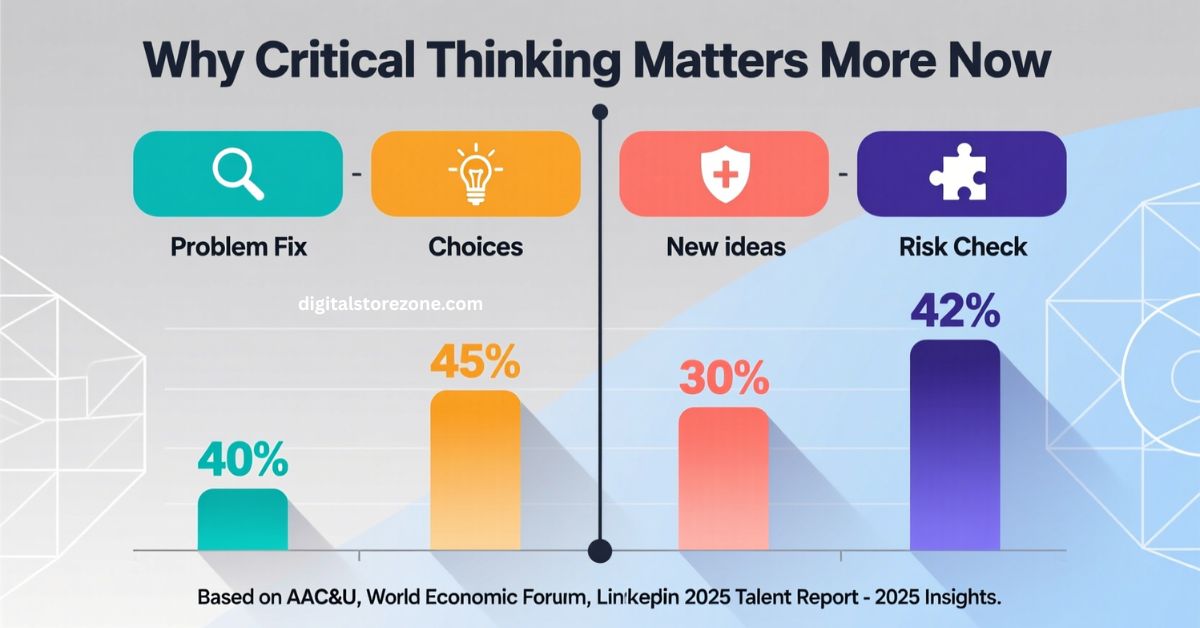
Good thinking leads to better results. You solve issues faster, talk clearer, and spot tricks. At work, it helps you stand out.
New stats show why it’s big. In 2025, 93% of bosses value critical thinking over a college degree, per AAC&U. The World Economic Forum says 39% of job skills will change by 2030, and thinking skills top the list. LinkedIn’s 2025 report notes 49% of leaders worry staff lack skills like strategy, which needs critical thought.
It cuts bias too. You see your own blind spots. Plus, it boosts confidence. You feel in control.
Here’s a quick table on how it helps at work:
| Skill Area | How It Helps | Boost Percent (from Studies) |
|---|---|---|
| Problem Fix | Find real issues quick | 40% faster fixes |
| Choices | Pick best options | 45% better outcomes |
| Data Check | Spot fake info | 30% less errors |
| New Ideas | Think fresh ways | 35% more creative |
| Risk Check | Avoid bad moves | 42% safer plans |
These numbers come from recent reports. They show real gains.
10 Simple Critical Thinking Exercises
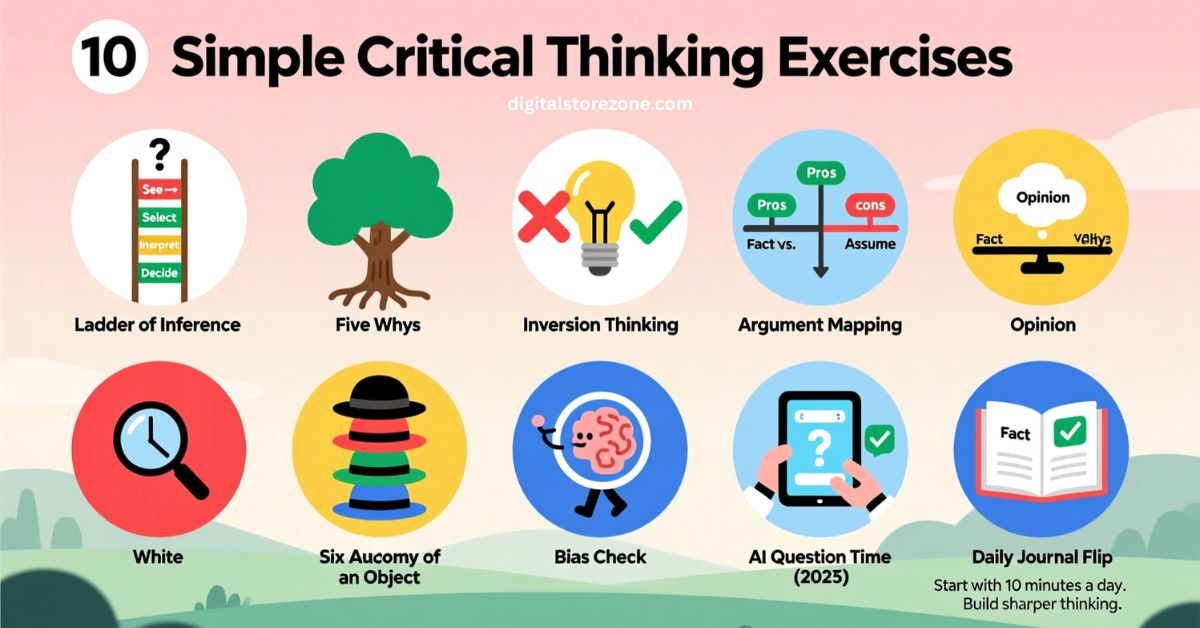
Here are 10 exercises to build your skills. I picked the top 7 from proven methods and added 3 new ones for today’s world. Each has steps and an example. Start with 10 minutes a day.
1. Ladder of Inference
This stops you from quick jumps.
Steps:
- Note what you see.
- Pick key facts.
- Add what you think it means.
- Check your beliefs.
- Decide slow.
Example: Your boss skips your idea in a meet. Don’t assume they hate it. Ask why.
2. Five Whys
Dig deep to find true causes.
Steps:
- Ask “Why?” five times.
- Write each answer.
- Stop at the root.
Example: Sales drop. Why? Less calls. Why? Staff busy. Why? Bad tools. Fix tools.
3. Inversion Thinking
Think of what could go wrong first.
Steps:
- List success goals.
- Flip to failures.
- Plan to avoid them.
Example: New job hunt. What fails it? Late apps. So set reminders.
4. Argument Mapping
Draw out pros and cons.
Steps:
- Write main idea.
- Add supports.
- Add counters.
- See which wins.
Example: Buy new car? Pros: Safe ride. Cons: Cost high. Map helps choose.
5. Fact vs. Opinion
Sort real from views.
Steps:
- Read a statement.
- Ask: Can I prove it?
- If no, it’s opinion.
Example: “Our team is best.” Opinion. “We won 5 awards.” Fact.
6. Autonomy of an Object
See things in new ways.
Steps:
- Pick an item.
- Think how it acts alone.
- Use in odd settings.
Example: Time as a friend. How does it help you? Plan better.
7. Six Thinking Hats
Look from six views.
Steps:
- White: Facts.
- Red: Feelings.
- Black: Risks.
- Yellow: Good sides.
- Green: New ideas.
- Blue: Big picture.
Example: Team project. Use hats to cover all angles.
8. Bias Check (New)
Spot your own tricks.
Steps:
- List your first thought.
- Ask: Why do I think that?
- Find proof against it.
- Adjust.
Example: You like a new app. Check reviews for bad sides too.
9. AI Question Time (New for 2025)
Test tech outputs.
Steps:
- Ask AI a question.
- Check facts.
- Ask why it said that.
- Fix errors.
Example: AI says eat apples daily. Why? Check health sites.
10. Daily Journal Flip (New)
Review your day backward.
Steps:
- Write what happened.
- Flip: What if different?
- Learn from it.
Example: Bad meet. What if I spoke first? Try next time.
These extras make it fresh. The bias one helps with self-tricks. AI fits now’s tech. Journal builds habit.
How to Fit These into Your Day
Don’t just read. Use them.
At work: Try Five Whys in meets.
At home: Use hats for family plans.
Start small. Pick one per week. Set phone reminders.
Team up: Share with friends. Practice together.
Common Mistakes and How to Fix Them
Many slip up. Here’s how to avoid.
- Rush: Take time. Fix: Set a timer.
- Ignore feelings: They matter. Fix: Use red hat.
- Stick to old ways: Miss new. Fix: Try inversion.
- No check: Assume right. Fix: Ask others.
This keeps you on track.
Critical Thinking in the AI Age
Tech changes things. AI helps but can fool.
Watch for fake news. Use fact check.
Train with AI: Ask it puzzles, then solve yourself.
Per LinkedIn, 51% of top firms use AI for skills. Blend it with your think.
Track Your Progress
See if you improve.
- Log choices: Note before and after.
- Ask feedback: From boss or pals.
- Test scores: Online quizzes.
- Count wins: Less bad picks?
Aim for small gains. In months, you’ll see big change.
Your Critical Thinking Toolkit
Pick the right tool.
| Exercise | Best For | Time | Level |
|---|---|---|---|
| Ladder | Check assumes | 10 min | Easy |
| Five Whys | Root cause | 15 min | Easy |
| Inversion | Risks | 20 min | Medium |
| Mapping | Debates | 30 min | Medium |
| Fact/Opinion | Info check | 10 min | Easy |
| Autonomy | Creative | 25 min | Hard |
| Hats | Groups | 45 min | Medium |
| Bias Check | Self fix | 15 min | Easy |
| AI Question | Tech | 20 min | Medium |
| Journal Flip | Review | 15 min | Easy |
This table adds our new ones. Use it to choose.
Build Stronger Thinking Habits
Keep at it. Read simple books. Play brain games.
Rest well. Tired brains think poor.
Mix with exercise. Walk and think.
Over time, it gets easy. You’ll thank yourself.
Conclusion
You’ve got the tools now—10 powerful critical thinking exercises to sharpen your mind and tackle life’s challenges head-on. From spotting biases to digging into root causes, these steps build habits that lead to smarter choices at work, home, and beyond. Start small, practice daily, and watch how you outthink problems others miss. Your brain is your best asset; give it the workout it deserves. Which exercise will you try first? Share in the comments and let’s grow together!
FAQs
How do I start if I’m new?
Pick easy ones like Five Whys. Do one a day.
Does this help at work?
Yes. Bosses want it. It leads to raises.
How often to practice?
Daily, 10-15 min. Like gym for brain.
What if I get stuck?
Ask a friend. Or try a new exercise.
Can kids do these?
Sure. Make simple. Helps school.
How to use with teams?
Share hats or mapping. Makes meets better.
Does AI replace thinking?
No. It helps, but you check it.
How to measure gains?
Track choices. See fewer mistakes.
Are there apps for this?
Yes, but start with paper.
What if I have no time?
Do quick ones. Like fact check news.