
Earth science is all about our world. It looks at the ground under your feet, the water in rivers, and the air you breathe. We study how these parts work together. This helps us know our planet better. In this guide, I’ll explain key topics. We’ll cover what others do, plus extra stuff like new finds and fun activities. You’ll see why earth science matters to you.
Contents
What Is Earth Science?
Earth science studies the solid Earth, its waters, and the air around it. It includes fields like rocks, weather, and oceans. The goal? To understand how Earth looks now and how it changed over time. We use this knowledge to help people, like finding clean water or predicting storms.
Scientists observe things. They describe what they see. Then they sort facts and make guesses. Last, they check if those guesses are right. Earth science links to other subjects like physics and biology. It’s a team effort.
One big part is that Earth is hard to study up close. Some rocks are deep underground. Air is high up. Time is another challenge. Earth is billions of years old. We can’t go back to see dinosaurs or early oceans. But we use clues like fossils to figure it out.
Why Study Earth Science?
You might wonder, “Why bother with this?” Earth science helps solve real problems. It shows us how to protect the planet. Think about climate change. We learn ways to cut pollution and save energy.
It leads to cool jobs too. You could be a geologist finding gems. Or a weather expert warning about hurricanes. Some work on space rocks from other planets. These jobs pay well and let you travel.
Plus, it’s fun! Knowing earth science makes hikes more exciting. You spot rock types or understand why rivers bend. It connects you to nature. Start small – read books or watch videos. You’ll see the world in a new way.
The Main Areas of Earth Science
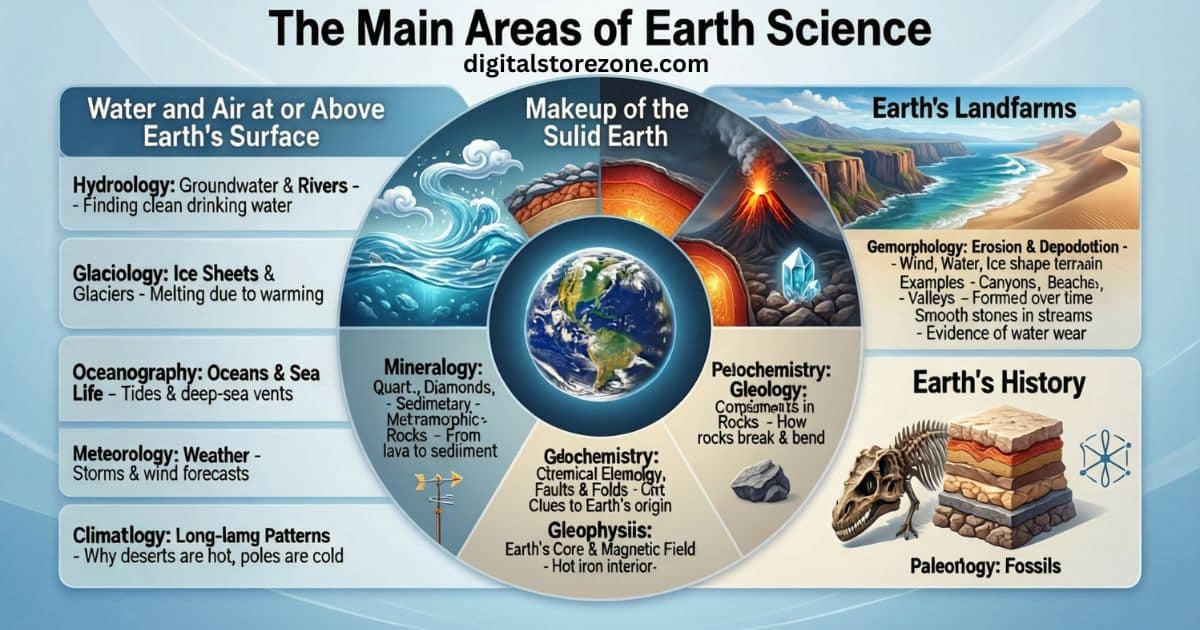
Earth science has six main groups. Each focuses on different parts of our planet. I’ll explain them simply. We’ll add examples and tips to make it clear.
Here’s a quick table to show the groups, what they study, and real examples:
| Group | What It Studies | Examples |
|---|---|---|
| 1. Water and Air at or Above Earth’s Surface | How water and air move and change | Rivers flooding, rain patterns, ice melting in poles |
| 2. Makeup of the Solid Earth | What Earth is made of inside | Types of rocks like lava rocks, earthquakes from shifting plates |
| 3. Earth’s Landforms | Shapes of land like mountains and valleys | How wind carves canyons, beaches forming from waves |
| 4. Earth’s History | How Earth changed over millions of years | Dinosaur fossils, layers of rock telling old stories |
| 5. Using Earth Science in Real Life | Ways to use Earth’s resources safely | Finding oil, building safe bridges, stopping landslides |
| 6. Earth Science in Space | Links between Earth and other worlds | Meteor craters on Earth, rocks from the Moon |
Now, let’s break each down.
Water and Air on Earth’s Surface
This group looks at water on land, in ice, and oceans. It also covers air and weather.
- Hydrology: Water in ground and rivers. Helps find clean drinking water.
- Glaciology: Ice sheets and glaciers. We watch them melt due to warm weather.
- Oceanography: Oceans and sea life. Covers tides and deep-sea vents.
- Meteorology: Weather like storms and winds. Predicts if you’ll need an umbrella.
- Climatology: Long-term weather patterns. Explains why some places are hot or cold.
You see this every day. Rain fills lakes, wind blows leaves.
The Makeup of Solid Earth
Here, we study what’s under the dirt.
- Mineralogy: Minerals like quartz or diamonds.
- Petrology: Rocks – hot ones from volcanoes, layered ones from rivers.
- Geochemistry: Chemicals in rocks. Tells us about Earth’s start.
- Structural Geology: How rocks bend or break.
- Geophysics: Earth’s inside, like its hot core.
Earth has layers: crust, mantle, core. The core is iron and very hot.
Earth’s Landforms
This is geomorphology. It explains hills, plains, and coasts.
Wind, water, and ice shape land. Rivers cut valleys. Waves build beaches. Over time, mountains wear down.
You can spot this on a walk. Look for smooth stones in a stream – water made them round.
Earth’s Long History
We use clues to learn the past.
- Paleontology: Fossils of old plants and animals.
- Stratigraphy: Rock layers stacked like a cake.
- Geochronology: Dating rocks with special tests.
Earth is 4.5 billion years old. Life started simple, then grew complex.
Using Earth Science in Real Life
This applies knowledge to help us.
Find fuels like coal or oil. Hunt minerals for phones. Use hot ground water for power.
It warns of dangers: earthquakes, volcanoes, floods. Engineers build safe homes with this info.
Earth Science in Space
Called astrogeology. Studies Moon rocks and planets.
Meteor hits leave craters. Glassy bits from impacts tell stories. We compare Earth to Mars or Venus.
Big Challenges in Earth Science
Studying Earth isn’t easy. Many spots are hard to reach. Deep oceans or underground caves hide secrets. We use tools like drills or robots.
Time is tricky too. Changes happen slow, over millions of years. We can’t watch a mountain grow. Instead, we look at clues like old rocks.
But tech helps. Satellites see from space. Computers model weather.
Recent Discoveries in Earth Science
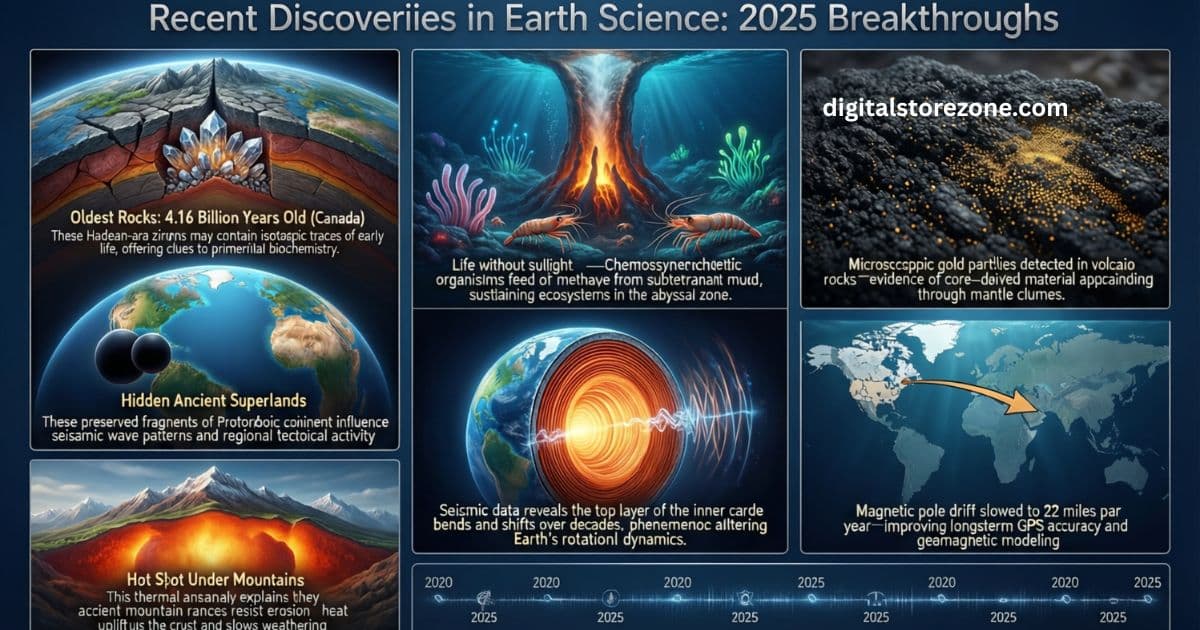
Science keeps finding new things. Here are some from 2025 that wow us.
- Oldest rocks: In Canada, rocks from 4.16 billion years ago. They might hold signs of early life.
- Deep sea life: In super-deep ocean spots, animals live off methane gas from mud. No sun needed.
- Earth’s core leaks gold: Tiny bits of gold sneak up from the core. Found in Hawaii rocks.
- Hidden old lands: Big chunks of ancient super lands sit in the mantle. They affect quakes.
- Inner core changes: The core’s top layer bends and shifts, shown by quake waves.
- Magnetic pole slow down: The north magnetic pole moves slower now, at 22 miles a year. Helps GPS work better.
- Hot spot under mountains: A warm rock blob under old US mountains explains why they don’t wear away fast.
These show Earth still has surprises. We learn more each year.
Fun Ways to Learn Earth Science at Home
Want to try earth science? Here are simple activities. No fancy tools needed.
- Rock hunt: Collect stones outside. Sort by color or shape. Look up types online.
- Make a volcano: Mix baking soda and vinegar in a bottle. Watch it fizz like lava.
- Weather journal: Note daily sky and temp. Spot patterns over a week.
- Fossil fake: Press leaves in clay. Let dry to make “fossils.”
- Water cycle bag: Put water in a zip bag. Hang in sun. See it evaporate and rain inside.
These are safe and fun. Do them with friends or family. You’ll learn while playing.
Wrapping Up
Earth science shows us how our planet ticks. From rocks under your feet to storms in the sky, it all links up. You’ve seen the main groups, fun facts, and ways to start learning. Use this knowledge to spot changes around you, like warmer days or new land from volcanoes. Stay curious – our world has more secrets to share. If you dig deeper, you might help fix big issues like clean water or safe homes. Thanks for reading; now go explore!
Frequently Asked Questions
Here are common questions about earth science topics. I added more than basics to help you.
What are earth science topics? They cover six groups: water/air on surface, solid Earth makeup, landforms, history, real-life uses, and space links.
What do earth sciences entail? They study Earth’s parts and changes. Use observations and tests to understand now and past.
Why is earth science important? It helps predict weather, find resources, and protect from disasters. Plus, it teaches about our home.
How old is Earth? About 4.5 billion years. We know from rock dates.
What causes earthquakes? Plates under ground shift and bump. Releases energy.
Can I study earth science without school? Yes! Books, videos, and home tests work great.
What’s a recent big find? In 2025, we found the deepest ocean life spot, living on gas from mud.
How does climate change fit in? It’s part of weather studies. Shows how human acts warm the air and melt ice.
What’s the difference between weather and climate? Weather is day-to-day, like rain today. Climate is long-term patterns, like hot summers.
How can kids get into earth science? Start with rock collections or simple experiments. It’s easy and exciting.