

You use apps every day. Some feel smooth and helpful. Others feel confusing and slow. Good design makes the difference. In 2026, smart design thinking helps businesses create experiences people love. It mixes user needs with business goals and clear data.
This guide covers everything you need. We explain design thinking in simple terms. We show the main services top studios offer. You learn who benefits and why. Plus, we add fresh 2026 trends, step-by-step advice you can use today, and fixes for common mistakes. By the end, you will know how to make better products or pick the right help.
Contents
- 1 What Is Design Thinking? A Simple Explanation?
- 2 The Hallmark of Great Design Thinking – What Makes It Work?
- 3 Key Services in a Modern Design Studio
- 4 Industries That Need Great Design Right Now
- 5 Who Benefits from Working with Design Experts?
- 6 Real Impact: Stories from the Field
- 7 Latest Design Trends You Should Know for 2026
- 8 Step-by-Step: How to Start Using Design Thinking Today?
- 9 Common Mistakes and How to Fix Them?
- 10 Dashboard Design Tips for 2026: Do’s and Don’ts
- 11 The Future of AI in Design
- 12 Frequently Asked Questions About Design Thinking and UI/UX
- 13 Conclusion
What Is Design Thinking? A Simple Explanation?
Design thinking is a way to solve problems by putting people first. You start with the user. You ask: What do they need? What frustrates them?
It has five basic steps:
- Empathize: Talk to users and watch how they act.
- Define: Write down the real problem.
- Ideate: Brainstorm lots of ideas.
- Prototype: Make quick models.
- Test: Try it with real people and fix what fails.
You repeat these steps until it works. This method started years ago but still powers big wins today. Companies use it to build apps, websites, and whole services that feel natural.
The Hallmark of Great Design Thinking – What Makes It Work?
Great design thinking mixes smart research with creative work. It started gaining power around 2004 for big projects. The best teams focus on real user pain and business success at the same time.
They do not guess. They test ideas fast and cheap. This cuts waste and raises success rates. Studies show that every dollar spent on good UX can bring back 100 times more in revenue. That is huge.
In 2026, the best work also adds AI carefully. But it always keeps humans in charge. The hallmark is simple: understand people deeply, then build with data and care.
Key Services in a Modern Design Studio
Top design studios offer four main services. Each one helps in a different way.
Service Design: Fixing the Whole Experience
Service design looks at the full journey. It covers every touch point – app, email, call center, or store. The goal is smooth flow from start to finish. Businesses use it to turn one-time users into loyal fans.
UI/UX Design: Making Screens Easy and Fun
UI is what you see and tap. UX is how it feels. Good UI/UX makes screens clear, fast, and enjoyable. In 2026, it includes voice controls and adaptive layouts that change with your needs.
Data Services: Turning Numbers into Clear Pictures
Data services build dashboards and charts. They take complex info and make it simple to read. A good dashboard shows exactly what matters in seconds. You avoid overload and make quick decisions.
Research Services: Asking Users the Right Questions
Research finds out what users really think. Teams run interviews, surveys, and tests. They mix numbers (quantitative) with stories (qualitative). This uncovers hidden needs and proves ideas work.
Industries That Need Great Design Right Now
Many fields gain from strong design. Here are the top ones:
- News, Media & Entertainment: Apps and streaming sites need fast, beautiful interfaces. Users expect quick video loads and easy searches.
- Enterprise & IT: Big companies use design for tools like HR systems or data planners. Simple interfaces save time and cut errors.
- Healthcare & Lifesciences: Hospital apps, wearables, and fitness trackers must feel safe and clear. Lives can depend on good UX.
- Networks & Smart Devices: IoT gadgets and home automation need intuitive controls.
- Education & Edtech: Learning platforms and apps work best when they feel fun and easy for all ages.
- Banking & Financial Services: Fintech apps handle money. Trust comes from clean design and simple steps.
Each industry has unique users. Design teams tailor every detail to fit.
Who Benefits from Working with Design Experts?
Big companies, startups, government offices, and teams of all sizes win with good design help. Fortune 500 firms use it to stay ahead. Startups use it to launch fast and grow. Even public services improve when they listen to citizens.
The key is teamwork. Designers bring fresh eyes. Clients bring deep industry knowledge. Together they create magic.
Real Impact: Stories from the Field
One entertainment app reached over 100 million users after a redesign. Banks launched digital tools that feel like magic instead of paperwork. Healthcare systems now help doctors and patients connect better.
These wins happen because teams research first, build quick tests, and measure results. The best projects impact millions and save time and money.
Latest Design Trends You Should Know for 2026
Design keeps changing. Here are the big moves this year:
- AI that helps quietly: Agentic AI works in the background. It finishes tasks for you without constant clicks.
- Immersive and 3D elements: Websites feel more real with depth and movement.
- Voice and mixed reality: Talk to interfaces or blend digital with the real world.
- Adaptive transparency: Screens look like glass and change based on light or focus.
- Trust-focused AI: Users worry about AI. Clear explanations and easy controls build confidence.
- Bold colors and simple navigation: Bright palettes and fun menus keep users happy.
Teams now design for intent – what the user wants right now – instead of just pretty screens.
| Trend | Why It Matters | Quick Tip |
|---|---|---|
| Agentic AI | Saves time | Test one small task first |
| 3D Immersive | Feels modern | Use it only where it adds value |
| Voice Interfaces | Hands-free | Speak like a friend |
| Adaptive Transparency | Looks fresh | Keep text readable |
Step-by-Step: How to Start Using Design Thinking Today?
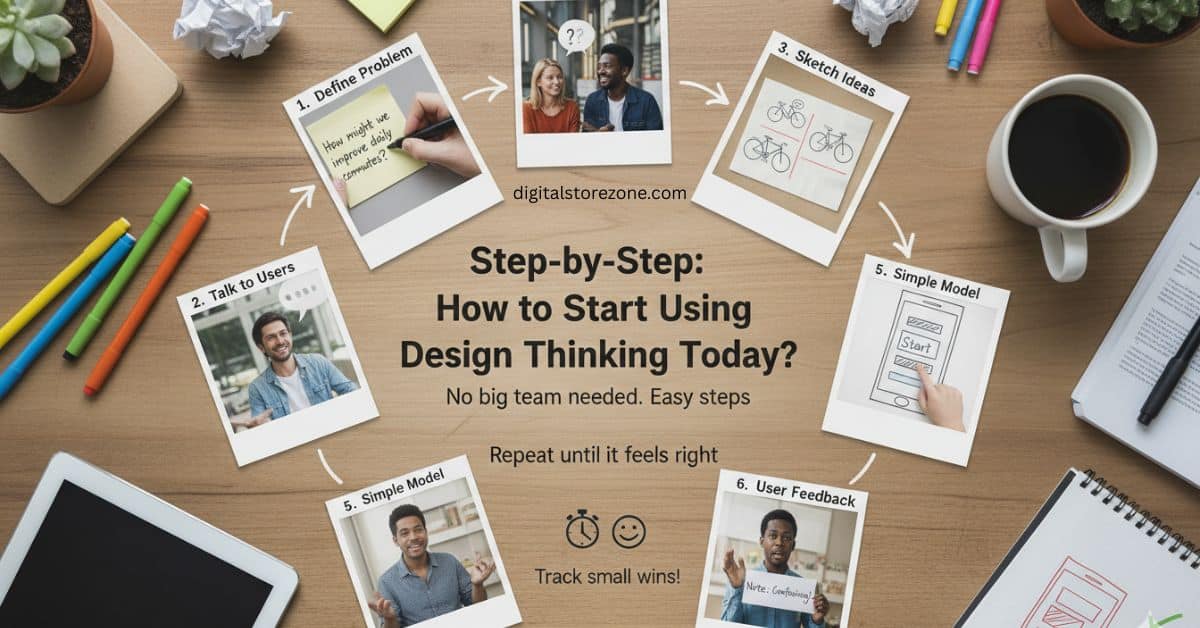
You do not need a big team to begin. Follow these easy steps:
- Pick one problem. Write it in one sentence.
- Talk to five real users. Ask open questions.
- Draw three quick ideas on paper.
- Make a simple clickable model (even on paper).
- Show it to users and note what confuses them.
- Fix and test again.
Repeat until it feels right. Track small wins like faster task completion or happier feedback.
Common Mistakes and How to Fix Them?
Many projects fail for the same reasons. Avoid these:
- Guessing instead of researching. Fix: Always talk to users first.
- Too many features on one screen. Fix: Show only 5-7 key items.
- Ignoring mobile users. Fix: Test on phones early.
- Pretty but useless dashboards. Fix: Start with the decision the user must make.
Fixing these early saves months of rework.
Dashboard Design Tips for 2026: Do’s and Don’ts
Dashboards help leaders see data fast. Here is what works now.
Do:
- Put the most important number top left.
- Use clear charts that match the data.
- Add short labels and plenty of white space.
- Make it accessible for everyone.
- Limit to 5-9 metrics per view.
Don’t:
- Stuff every possible chart.
- Use 3D effects that confuse.
- Forget context like trends or goals.
- Hide filters or make them hard to find.
Good dashboards feel instant. Bad ones cause wrong choices.
| Do | Don’t |
|---|---|
| One main metric in focus | Ten small charts everywhere |
| Simple colors with meaning | Rainbow of random colors |
| Short text explanations | Walls of tiny numbers |
The Future of AI in Design
AI now helps generate ideas and layouts. But the best designers use it as a helper, not the boss. In 2026, expect more tools that suggest prompts, build prototypes, and test automatically. Still, human empathy stays key. AI cannot feel what a user feels.
Frequently Asked Questions About Design Thinking and UI/UX
What is the difference between UI and UX? UI is the look and buttons. UX is the full feeling and flow.
How long does a design project take? Small updates take weeks. Big apps take months. Good research adds time but saves money later.
Do small businesses need design thinking? Yes. Even one clear improvement can boost sales and keep customers.
Is AI replacing designers? No. AI speeds up tasks. Designers still guide the vision and test with real people.
How much does good UX return? Many studies show big returns – up to 100 times the cost in extra revenue and loyalty.
What if users hate the first test? That is normal and good. Change it and test again.
Can I learn design thinking myself? Yes. Start with the five steps and practice on small projects.
Why does accessibility matter? It opens your product to more people and often makes it better for everyone.
Conclusion
In 2026, great UI/UX design is all about understanding real users, solving the right problems, and using data wisely. By applying simple design thinking steps, focusing on clear and intuitive interfaces, and testing ideas early, you can create products that feel smooth, useful, and trustworthy. Whether you’re a beginner or a growing business, small improvements in user experience can lead to big results—more engagement, happier users, and better success overall.